In the programme
In conversation with Krzysztof Zanussi
Straight after the address, on the same stage and without a break: a conversation where the questions are answered by a man who taught generations of directors that a camera is an instrument for thinking. The questions come from the room, so the shape of this hour depends on who turns up. A good place for anyone who wants to test their own view of artificial intelligence against someone who looks at it from sixty years of work with the image rather than from the latest tool.
- Straight after the keynote, on the same stage
- Questions from the room
Who
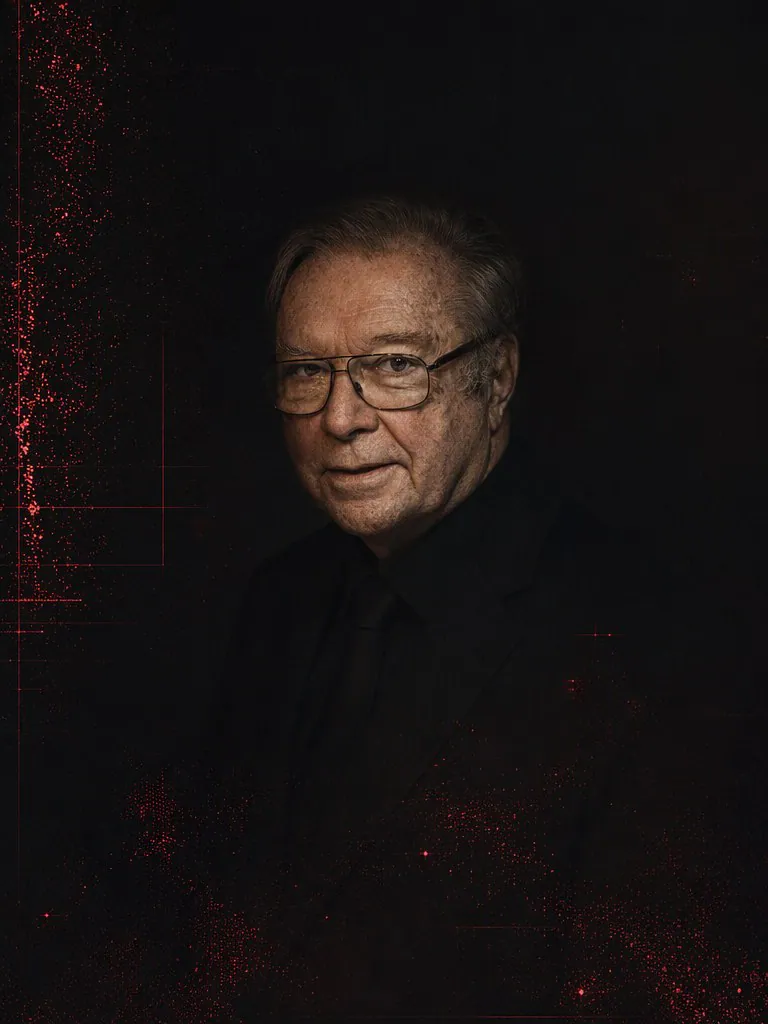
Krzysztof Zanussi
Director · Educator · Poland
A director, screenwriter, producer and actor, born in Warsaw in 1939, whose work belongs to two currents of Polish cinema: the cinema of Young Culture and the cinema of moral anxiety. He began by studying physics at the University of Warsaw, left it in 1959 for philosophy at the Jagiellonian University, left that in turn, and finally took directing at the Lodz Film School, graduating in 1966. Of his eight student shorts the most important was The Death of a Provincial, which won prizes at international festivals, among them the Golden Ducat at Mannheim.
He built a reputation as an intellectual working on morality, faith, evil and what it is to be human, with The Structure of Crystal (1969), Illumination (1972), Camouflage (1976), The Spiral (1978), The Constant Factor (1980) and Imperative (1982). He has shot in Poland and abroad, in West Germany, Italy and Russia. He took the Golden Lion in Venice for A Year of the Quiet Sun (1984) and the Grand Prix of the Polish Film Festival twice, for Camouflage and for Life as a Fatal Sexually Transmitted Disease (2000). As a producer he stood behind other directors' films, among them Wojciech Marczewski's Weiser, Magdalena Piekorz's The Welts and Agnieszka Holland's Spoor.
A professor of film arts since 1992 and a Commander of the Order of Polonia Restituta, he has taught generations of directors that a camera is an instrument for thinking. At Warsaw Glitch he opens the festival with the keynote The Age of Transhumanism, stays for a conversation on the same stage and joins the Friday panel on a human story typed on a machine.